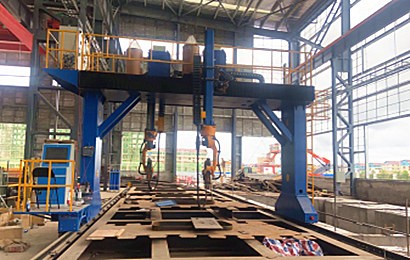
Heavy‑duty metal fabrication continues to face real‑world obstacles when processing large and bulky components. Extended weld runs, component misalignment, high labour turnover and inconsistent weld quality from manual operations often create bottlenecks that hold back overall factory output. The dual‑robot gantry welding workstation addresses these industrial pain points through a flexible automated setup, where two robotic welding units ride on a heavy‑duty travelling gantry frame built for oversized workpiece production.
Built for real‑world shop‑floor conditions, this complete welding solution integrates heavy‑load gantry beams, extended ground travel rails, paired robotic arms, synchronised motion control, laser vision seam tracking, industrial welding power sources and safety perimeter guarding alongside a central HMI for easy parameter management. Unlike fixed robot cells or single‑head gantry equipment, the travelling gantry extends the effective working envelope far beyond standard robot reach. The twin robots can work in seamless coordination to weld opposite sides of one large assembly simultaneously, or operate independently to process separate workpieces on the same station. Sophisticated anti‑collision logic safeguards equipment during complex movement paths. The platform supports MIG/MAG, TIG and plasma cladding workflows, while gantry span, rail length and payload can all be modified to match unique workpiece sizes and site layout requirements.
Running two robots in coordinated motion delivers substantial productivity gains over single‑head gantry alternatives. Synchronised welding along symmetric seams cuts down on repeated workpiece handling, flipping and re‑fixturing that consumes valuable production time. Even thermal distribution from dual‑sided welding helps minimise part distortion, reducing time spent on post‑weld straightening and rework. Thanks to ground‑rail travel, the workstation easily accommodates long steel beams, box girders, bridge assemblies, large valve castings and offshore structural parts that cannot fit within conventional robotic work cells.
Onboard laser vision tracking dynamically corrects for fit‑up gaps and positional drift that commonly occur with large heavy parts. Multi‑layer, multi‑pass welding sequences run automatically, with all process settings saved for consistent repeat production. This capability supports both structural fusion welding and surface hardening via plasma cladding on valve sealing faces, giving manufacturers a versatile asset that serves mixed‑batch and high‑volume production alike. Optional offline programming simplifies preparation for complex part geometries and cuts down on on‑site teaching time.
One operator can monitor and manage the whole workstation, lowering reliance on hard‑to‑find experienced welders. Fully enclosed safety barriers separate staff from welding fumes and intense arc glare to improve site safety. Widely adopted across steel construction, energy valve manufacturing, shipbuilding, offshore and heavy‑equipment sectors, the workstation processes everything from structural beam fabrications to nuclear‑component cladding and mining equipment frames. Suppliers can deliver full turn‑key execution covering custom mechanical design, on‑site assembly, commissioning and hands‑on operator training aligned with each end‑user’s production goals.
By merging long‑travel gantry mechanics, coordinated dual‑robot motion and smart vision‑guided welding, the dual‑robot gantry welding workstation brings stable, repeatable automation to oversized metal assemblies, helping heavy‑industry facilities boost throughput while keeping weld quality under tight control.