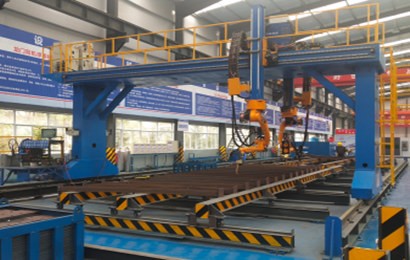
Modern heavy manufacturing constantly grapples with challenges brought by large‑size workpieces, lengthy welding seams, limited output, scarce skilled welders, inconsistent manual weld quality and unpredictable thermal deformation. The dual‑robot gantry welding workstation serves as a reliable turn‑key automated solution, mounting two synchronised robotic welding arms onto a heavy‑duty travelling gantry frame to cater for high‑demand large‑component fabrication.
This complete integrated system consists of robust gantry beams, long‑travel ground rails, twin industrial welding robots, multi‑axis synchronisation controls, laser seam‑tracking vision modules, welding power sources, safety enclosures and a central HMI control cabinet. Unlike single‑robot gantry units or fixed robotic welding cells, the travelling gantry expands the working scope far beyond the reach of conventional robot arms. The two robots can operate flexibly, either running in sync to weld the same large‑scale part simultaneously or performing separate welding jobs on individual workpieces. Built‑in anti‑collision algorithms prevent mechanical interference during complex motion paths to guarantee stable and safe operation. Compatible with MIG/MAG, TIG and plasma cladding processes, the workstation supports full customisation on gantry span, rail travel distance and load capacity to fit varied heavy‑industry production requirements.
Synchronised dual‑robot operation brings remarkable productivity gains, delivering 70‑100 percent higher throughput compared to single‑robot gantry systems. Dual torches complete symmetric seam welding at the same time, cutting down frequent workpiece flipping and re‑clamping steps. Balanced bilateral heat input greatly reduces thermal distortion on large weldments and minimises labour‑intensive post‑weld correction work. Benefiting from ground‑rail gantry design, the workstation easily processes extra‑long and extra‑wide components such as H‑beams, box girders, bridge panels, oversized valve bodies and offshore structural assemblies.
Real‑time laser seam‑tracking compensates for assembly gaps and workpiece positioning offset during production. Multi‑layer multi‑pass welding executes automatically with storable and repeatable process parameters, improving weld bead consistency and lowering defect rates for incomplete fusion and lack‑of‑penetration. Capable of both structural fusion welding and valve sealing surface plasma cladding, the workstation maintains high equipment utilisation and adapts well to mass repetitive production as well as low‑volume mixed‑batch manufacturing. Optional offline programming eases heavy teaching work for parts with complex geometries.
From operational perspective, one operator can oversee multiple workstation units, easing manufacturers’ dependence on hard‑to‑source skilled welders. Closed safety barriers isolate harmful arc light and welding fumes to improve workshop occupational safety. Widely deployed across steel construction, heavy‑duty valve manufacturing, shipbuilding, offshore engineering and mining machinery sectors, the system handles welding for structural beams, nuclear‑grade valve cladding, hull panels and heavy equipment frames. Full turn‑key custom service covers mechanical design, site installation, commissioning and operator training to match each customer’s on‑site conditions.
Designed to resolve key pain‑points within heavy fabrication including limited working range, insufficient single‑unit output, unstable manual welding quality and high labour pressure, the dual‑robot gantry welding workstation combines long‑travel gantry mechanics, coordinated dual‑robot movement and intelligent vision tracking. It delivers robust automation for oversized metal parts for steel‑structure, energy valve and marine industries.