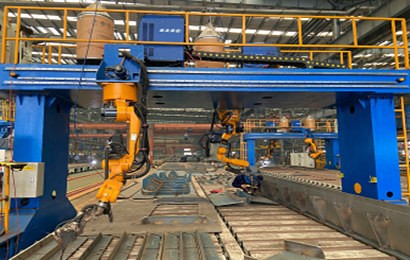
Modern heavy‑duty manufacturing faces persistent challenges including oversized workpieces, long‑seam production bottlenecks, shortages of skilled welders, inconsistent manual weld quality and uncontrollable thermal deformation. The dual‑robot gantry welding workstation provides a fully automated turn‑key solution for large‑scale fabrication by mounting two synchronized robotic arms onto a heavy‑duty traveling gantry frame.
This integrated welding system incorporates rigid gantry beams, long‑travel ground rails, twin industrial welding robots, a multi‑axis synchronous control unit, laser seam‑tracking vision hardware, welding power supplies, safety protective enclosures and a central HMI control cabinet. Unlike single‑robot gantry setups or fixed robotic welding cells, the gantry assembly travels along extended ground rails to break through the working‑range limitations of conventional robot arms. The two robotic units can operate in flexible modes, executing synchronized simultaneous welding on a single large component or running independent welding tasks on separate workpieces. Built‑in anti‑collision algorithms guarantee safe operation and prevent mechanical interference during complex motion trajectories. The workstation supports multiple proven welding processes covering MIG/MAG, TIG and plasma cladding, while gantry span, rail travel length and load‑bearing capacity can be fully customised to satisfy diverse heavy‑industry project requirements.
Productivity sees substantial improvement when dual‑robot synchronous welding is deployed, delivering 70‑100 % higher output compared with single‑gantry welding solutions. Two welding torches complete symmetric seam work concurrently, minimising time‑consuming part‑flip and re‑clamping operations. Balanced bilateral heat input from coordinated robot movement effectively mitigates thermal distortion across large weldments and cuts down labour‑intensive post‑weld correction work. Thanks to ground‑rail gantry architecture, the workstation easily processes extra‑long and extra‑wide workpieces out of reach for standard robotic equipment. Customisable rail length and gantry span make it well‑suited for H‑beams, box girders, bridge panel units, oversized valve bodies and offshore structural frames.
Integrated laser seam‑tracking technology carries out real‑time compensation for assembly gaps and workpiece positioning deviation. Automatic multi‑layer multi‑pass welding runs with stored and replicable process parameters, greatly improving weld bead consistency and lowering occurrence rates of typical defects such as incomplete fusion and lack‑of‑penetration. Capable of both structural fusion welding and plasma cladding for valve sealing surfaces, the workstation maintains high equipment utilisation and adapts smoothly to high‑volume repetitive batches as well as mixed low‑volume custom production scenarios. Optional offline programming also reduces heavy manual teaching workload for complex‑geometry components.
From an operational cost perspective, a single operator is able to supervise multiple workstation units. Automated welding lessens enterprise reliance on hard‑to‑recruit skilled welders. Closed safety barriers isolate harmful welding arc light and welding fume, optimising occupational safety conditions within workshops.
This versatile welding system finds wide application across multiple industrial sectors. Within steel construction it handles H‑beam and box‑beam fabrication alongside bridge panel unit welding. For valve and heavy‑machinery sectors it performs cladding tasks for large butterfly valves, ball valves and nuclear‑grade valve components. It also serves shipbuilding and offshore projects for deck structures and hull panel assemblies, as well as engineering‑machinery production for heavy equipment frames and mining machinery parts. Complete custom turn‑key services cover mechanical design, on‑site installation, system commissioning and hands‑on operator training tailored to individual factory‑site conditions.
The dual‑robot gantry welding workstation addresses core pain‑points of heavy fabrication including constrained robot working range, insufficient single‑head production capacity, unstable manual welding quality and mounting labour‑market pressure. By combining long‑travel gantry mechanics, coordinated dual‑robot motion and intelligent vision tracking functions, it delivers dependable automation solutions for oversized metal parts used in steel‑structure, energy‑valve and marine‑related industries.