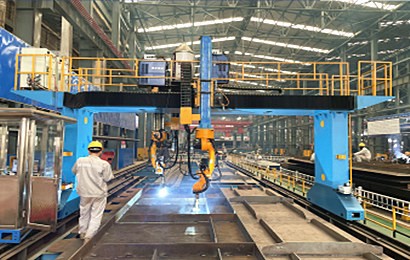
For manufacturers working with oversized steel frames, large valve castings and offshore structural parts, traditional welding methods frequently struggle with limited working range, slow cycle times and quality fluctuations caused by manual operation. The dual‑robot gantry welding workstation emerges as a practical automated solution, utilising a travelling gantry framework to carry two independent robotic welders and tackle the most demanding large‑component welding tasks in modern heavy‑industry production.
This complete turn‑key system consists of high‑strength gantry structures, long‑travel ground rail assemblies, dual robotic welding units, synchronised motion controllers, laser vision seam tracking modules, compatible welding power supplies and full safety guarding paired with an intuitive HMI control interface. Where single‑robot gantries are constrained by individual robot output, this setup unlocks flexible operating logic. The two robotic units can coordinate closely to complete symmetric seam welding on a single large workpiece, or work separately to process multiple parts in parallel without mutual interference. Advanced anti‑collision protection runs continuously throughout operation to avoid hardware damage during complex movement trajectories. Supporting MIG/MAG, TIG as well as plasma cladding processes, the workstation allows full customisation of gantry span, rail travel distance and load capacity to adapt to varied workpiece dimensions and factory floor layouts.
Coordinated dual‑robot operation optimises overall production efficiency without compromising welding quality. Simultaneous welding on symmetric seams reduces frequent workpiece repositioning, fixture adjustment and part flipping, cutting non‑productive handling time on the shop floor. Uniform heat distribution brought by dual‑sided welding suppresses thermal deformation of large weldments and reduces the volume of post‑weld repair and straightening work. Supported by extended ground rails, the workstation can handle extra‑large workpieces including box girders, bridge steel segments, heavy‑duty valve bodies and marine structural assemblies that exceed the working limits of standard fixed robot cells.
Integrated laser vision tracking performs real‑time adjustment to offset assembly gaps and positioning errors common among heavy workpieces. Pre‑saved multi‑layer multi‑pass welding parameters ensure stable and repeatable weld bead formation, effectively lowering the occurrence rate of welding defects such as incomplete fusion. Capable of both structural joint welding and surface plasma cladding for valve sealing surfaces, the workstation maintains high equipment utilisation whether for mass repetitive orders or mixed‑batch custom production. Optional offline programming further simplifies programming work for components with complex geometries.
A single technician can oversee the running of the entire workstation, easing manufacturers’ reliance on scarce experienced welders. Closed safety enclosures isolate harmful welding fumes and arc radiation to improve workplace safety standards. Widely applied in steel construction, energy equipment manufacturing, shipbuilding and engineering machinery sectors, the system delivers reliable welding performance for structural beams, nuclear‑grade valve cladding, hull panels and heavy equipment bases. Custom services cover mechanical design, on‑site installation, system commissioning and practical operator training tailored for individual production conditions.
Combining long‑travel gantry structure, synchronised dual‑robot movement and intelligent visual guidance, the dual‑robot gantry welding workstation brings reliable automation for large‑size metal components, helping heavy‑industry enterprises improve output while stabilising overall welding quality.