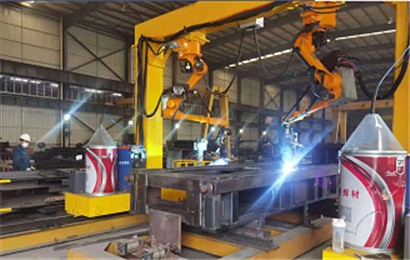
Fabricators specialising in heavy steelwork, energy valve production and offshore component manufacturing face persistent pressures from labour shortages, high rework rates and bottlenecks when processing extra‑large workpieces. Manual welding and single‑robot automated setups often struggle to balance speed, dimensional accuracy and stable weld quality. The dual‑robot gantry welding workstation provides a robust automation alternative, mounting two robotic welders on a mobile heavy‑duty gantry structure to address the unique demands of large‑scale component production.
Designed to withstand rigorous continuous workshop operation, this complete workstation incorporates heavy‑load gantry frames, extended ground rail systems, dual robotic welding manipulators, synchronised motion control logic, laser‑based seam‑tracking vision hardware, industrial welding power units and safety perimeter guards, with all operations accessible through a central HMI terminal. Where standard robot cells are confined by fixed reach and single‑gantry systems are limited by individual robot throughput, the travelling gantry unlocks expansive working zones. The twin robotic units can coordinate their movements to complete symmetric welding on a single oversized workpiece, or run autonomously to handle separate components within the same work envelope. Embedded anti‑collision functions continuously monitor robot positioning to avoid hardware damage during complex motion paths. Supporting MIG/MAG, TIG and plasma cladding applications, the system allows full customisation of gantry span, rail length and payload capacity to align with part dimensions and existing factory layouts.
Coordinated dual‑robot workflows drive meaningful improvements in overall production output. Simultaneous welding along matching seam lines reduces repeated fixture adjustment, part rotation and re‑clamping that eat into production time. Even heat distribution across weld zones minimises thermal distortion in large assemblies, lowering the volume of post‑weld straightening and repair work. Thanks to long‑travel ground rails, the workstation readily accommodates box girders, bridge steel segments, large valve castings and offshore structural frames that cannot fit inside conventional robotic welding cells.
Integrated laser vision compensates in real‑time for fit‑up gaps and positional shift common to heavy metal assemblies. Saved multi‑layer multi‑pass welding recipes deliver repeatable weld bead geometry and cut down on costly welding defects such as incomplete fusion. Suited for both structural fusion welding and plasma cladding on valve sealing surfaces, the workstation maintains high asset utilisation whether running high‑volume batch orders or mixed‑model custom manufacturing. Optional offline programming reduces time spent on‑site teaching for parts with complex contours.
A single operator can supervise the full workstation, easing reliance on hard‑to‑recruit experienced welders. Fully enclosed safety barriers protect staff from welding fumes and harmful arc glare to elevate site safety standards. Widely adopted across steel construction, power equipment manufacturing, shipbuilding and heavy engineering, the system supports production of structural beams, nuclear‑grade valve cladding and large mining equipment frames. Custom turn‑key delivery includes mechanical adaptation, on‑site installation, commissioning and hands‑on operator training tailored to each manufacturer’s production goals.
By combining long‑range gantry mobility, synchronised dual‑robot actuation and vision‑aided welding intelligence, the dual‑robot gantry welding workstation brings consistent automation to oversized metal assemblies, empowering heavy‑industry producers to raise throughput while tightly controlling final weld quality.