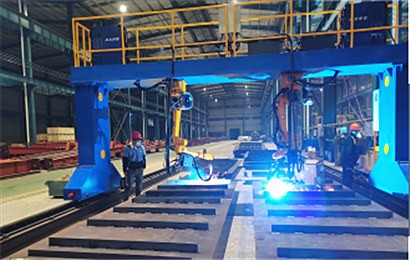
As heavy industries push toward higher automation, fabricators of large steel structures, energy valves and offshore components are constantly fighting against low output, part distortion and quality inconsistency brought by manual welding. The dual‑robot gantry welding workstation addresses these real‑world manufacturing pain points, utilising a heavy‑duty travelling gantry framework to carry two robotic welding units for automated processing of extra‑large and heavy workpieces.
This fully integrated industrial system is built around high‑strength gantry beams and long‑travel ground rails, paired with dual robotic arms, synchronised motion controllers, laser seam tracking vision, high‑performance welding power sources and safety enclosures, all managed via an intuitive HMI interface. Unlike fixed robot cells or single‑robot gantry units limited by individual working range, the travelling gantry expands coverage over lengthy work zones. The two robots can move in perfect sync to weld symmetric seams on one large assembly, or work independently to process separate parts simultaneously. Continuous anti‑collision monitoring protects mechanical hardware during complex movement. Compatible with MIG/MAG, TIG and plasma cladding processes, the workstation allows flexible adjustment of gantry span, rail travel distance and load capacity to fit diverse workpiece sizes and existing factory layouts.
Running two robots in coordinated motion delivers notable efficiency gains over single‑head welding solutions. Synchronised welding reduces frequent fixture adjustment, workpiece flipping and repositioning that waste production hours. Even heat input from dual‑sided welding minimises thermal deformation of large weldments, cutting down post‑weld correction and rework. Supported by ground rail travel, the workstation easily handles box girders, bridge steel components, large‑size valve bodies and offshore frames that exceed the operating limits of conventional robotic cells.
Laser vision seam tracking dynamically offsets assembly gaps and positioning deviations which frequently occur with heavy metal parts. Multi‑layer multi‑pass welding sequences can be stored as reusable recipes, ensuring consistent weld bead formation and reducing defects such as incomplete fusion. Able to execute both structural joint welding and plasma cladding for valve sealing surfaces, the equipment maintains high utilisation whether for mass‑produced parts or mixed‑batch custom orders. Optional offline programming simplifies preparation work for complex‑shaped components.
Only one technician is required to monitor the whole workstation, easing dependence on scarce skilled welders in the labour market. Closed safety barriers separate operators from harmful welding fumes and strong arc radiation, improving overall site safety. Widely deployed across steel construction, power equipment manufacturing, shipbuilding and engineering machinery sectors, it serves beam fabrication, nuclear‑grade valve cladding and heavy mining equipment production. Full turn‑key support includes custom mechanical design, field installation, commissioning and practical operator training tailored for each production site.
Blending long‑travel gantry mechanics, coordinated dual‑robot movement and intelligent vision‑guided welding, the dual‑robot gantry welding workstation delivers reliable automation for oversized metal parts, enabling heavy‑industry manufacturers to boost production capacity while stabilising final weld quality.