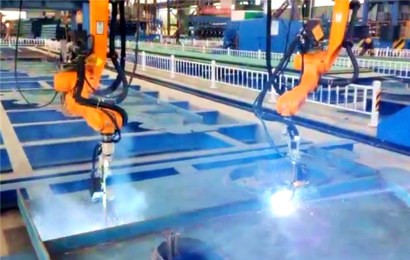
The dual‑robot cantilever welding workstation adopts overhead cantilever‑hanging dual‑robot structure for large‑stroke collaborative welding. It is designed for heavy long‑seam steel workpieces such as H‑beam main & secondary beams, box‑type components and bridge plate units. Two 6‑axis welding robots are suspended on the longitudinally‑movable cantilever beam, working synchronously or independently. The overhead layout saves floor space while covering wide welding zones of large components.
The workstation is equipped with two sets of 6‑axis welding robots with 2010 mm maximum reach, 6 kg payload and ±0.05 mm repeat positioning accuracy. The cantilever beam features long‑travel X‑axis rack‑and‑pinion drive with customizable stroke. It includes dual MIG/MAG welding power sources, heavy‑duty water‑cooled anti‑collision torches, laser vision seam‑tracking system, torch cleaning‑wire‑cutting station and integrated electric control cabinet. Total power reaches 30 KW, and average daily welding output ranges 140‑200 meters.
Laser vision tracking compensates dimensional errors from cutting and assembly to realize stable fillet welds, lap welds and multi‑layer multi‑pass welding. The overhead cantilever layout leaves floor area free for workpiece placement and overhead‑crane loading. Dual robots can process different welding zones simultaneously to boost cycle time, or run in single‑robot mode for small‑batch production.
Modular construction simplifies on‑site assembly and commissioning. Cantilever travel and span can be custom‑engineered. It delivers consistent weld quality and lowers rework rate to ease the shortage of skilled welders. Widely applied in building steel‑structure and bridge heavy‑industry, it acts as an efficient flexible welding solution for heavy steel components.